Chicago
Native SonChicago is the setting of Native Son and more than a backdrop to its events: the city’s racial boundaries, unequal housing, and contrasts between deprivation and wealth shape the possibilities available to Bigger Thomas. Its streets connect private choices to larger systems of power, while its winter landscape helps determine the course of the novel’s pursuit and capture.
The City as Setting and Social Landscape
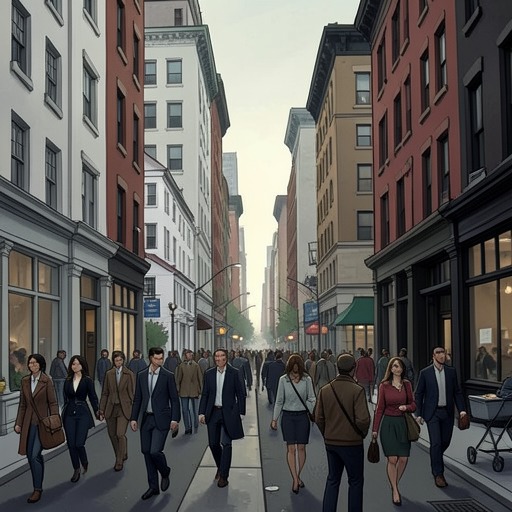
Native Son presents Chicago as a city of extremes. In Richard Wright’s description, it is immense and noisy, with crowded streets and both poverty and luxury, idealism and cynicism, Black residents and white residents, and people of varied origins and languages. Its physical and social contrasts make it a setting in which aspirations are visible but unevenly available. The city’s scale gives individual experience a wider frame: it is not only the place where Bigger lives, but a meeting ground for forces operating across the nation.
Wright also gives Chicago a presence approaching that of a character. The city is associated with darkness and violence, and its built environment bears the marks of sharply unequal life. The description ranges from harsh winters and summers to industrial smoke that obscures the sun for much of the year and the proximity of the stockyards. These details establish a place where daily life is shaped by both material conditions and accumulated social divisions. Chicago’s comparatively short history, set against its broad national importance, further makes it a concentrated stage for conflicts that extend beyond the city itself.
Housing and the Color Line
The city’s most consequential boundary in Bigger’s life is the residential line separating Black and white residents. He understands that the two groups inhabit different parts of the city and have unequal access to possessions and activities. The division feels to him like exclusion from the wider world: he describes an existence in which he can look outward but cannot freely enter. This perception is not simply an individual fear; the novel connects it to the prescribed area in which Black residents are permitted to live.
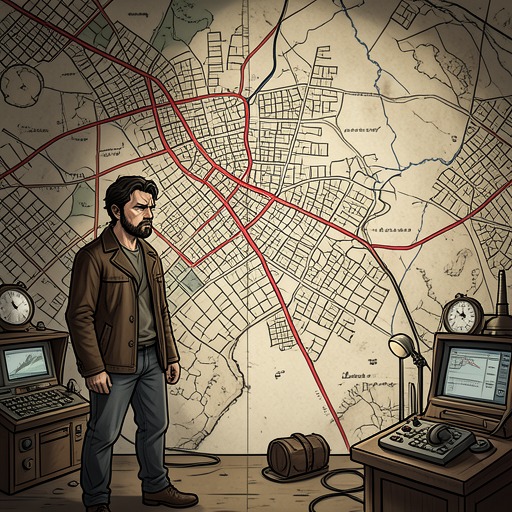
That restriction becomes concrete when Bigger notices a property sign identifying the South Side Real Estate Company. He knows that Mr. Dalton owns the company and that it owns the house where Bigger’s family lives. The family pays eight dollars a week for one rat-infested room, while Mr. Dalton’s property extends into areas where white people live. Yet Bigger cannot rent across the racial line. Mr. Dalton’s donations to Black education do not alter this housing practice: the properties he rents to Black tenants remain confined to a deteriorating section of the city. Chicago’s segregation therefore appears not only as an attitude but as a structure of ownership, rental policy, and limited residential choice.
The inquest sharpens the geographic nature of that inequality. When Max questions Mr. Dalton about the housing shortage, Dalton acknowledges that it applies on the South Side rather than throughout Chicago. The exchange connects the family’s crowded housing to a specifically localized deprivation, not a citywide absence of homes. The contrast between the company’s reach across the city and the narrow area available to Black tenants makes the color line visible as a decision governing space.
Routes, Snow, and the Plot
Chicago’s streets and institutions shape the practical sequence of the novel. After taking Mary Dalton’s trunk from the Dalton home, Bigger drives it to La Salle Street Station, places it at a platform, and obtains a ticket for it. He then returns to the house, intent on appearing as though nothing has happened. The station is one point in a city network that Bigger tries to use to conceal what occurred; his ordinary-looking movements through the city become part of his attempt to control suspicion.
Later, the search for a suitable building for the ransom scheme leads Bigger through streets of empty properties. He rejects buildings he considers unsafe and looks for one on a corner with windows from which Bessie could watch in several directions. At a property sign, the city’s housing system interrupts his immediate planning: the address and company name call attention to the unequal ownership that has already shaped his family’s home. The episode links the mechanics of the plot to the geography of segregation without making those two things equivalent. Bigger’s criminal decisions are his own actions, while the restricted environment in which he acts is part of the social world the novel examines.
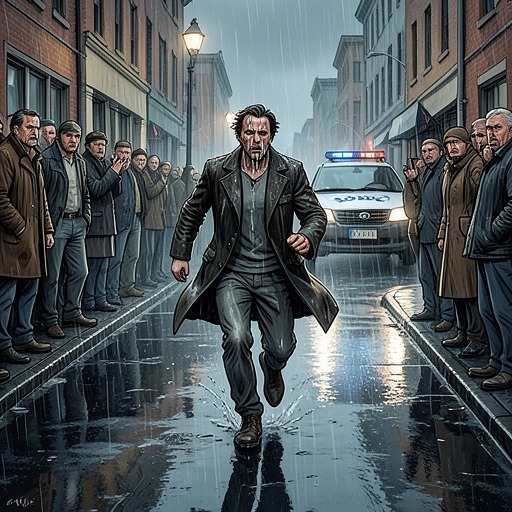
Snow also determines the novel’s closing movement. As the pursuit narrows, the snow-covered city helps trap and deliver Bigger to his fate. Earlier, he has seen Black people on snowy sidewalks and recognized a shared condition of fear and shame, but he cannot turn that recognition into durable solidarity. He imagines collective action, then feels divided from the people around him. The city thus offers proximity without guaranteeing connection: residents share streets and conditions, yet racial power and internal estrangement hinder a common life.
Political Power in the City
Chicago’s political and economic institutions become visible during the trial. Max argues that the mob outside the courthouse has been incited, and he connects its fury to public messaging and the interests of powerful groups. In his account, the State’s Attorney has made promises to Loop bankers, the Governor has pledged action against striking workers to the Manufacturers’ Association, and the Mayor has addressed merchants’ concerns about budgets and taxes. These claims are part of Max’s courtroom argument: he presents the anti-Black hysteria surrounding the case as politically useful to people seeking to protect their interests and suppress demands from the needy.
The city in this account is not reducible to the mob. It includes the agencies of communication that Max accuses of spreading lies, the officials and business groups he says benefit from public fear, and the people gathered outside the courtroom. His speech connects the immediate threat to Bigger with a broader urban order in which racial hostility, economic power, and political calculation converge. Chicago’s public life therefore extends the novel’s attention from housing and streets to institutions capable of directing popular anger.
Wright’s Chicago and the Novel’s Reach
Wright’s reflections on Chicago explain how the city helped him recognize Bigger as more than a narrowly local figure. He recalls that moving to Chicago freed him from the daily pressure of his Southern environment, while contact with the labor movement and its ideas helped him understand what Bigger represented. He came to see that Bigger could be understood across racial lines and that similar patterns of frustrated behavior existed among white people as well. This recognition broadened his sense of the novel’s subject from an account of Black life alone to a struggle involving many lives in America.
The city’s urban environment is central to that change in perspective. Wright contrasts Chicago’s crowded, stimulating life and apparent signs of power and fulfillment with the restrictions imposed by segregation. In his account, the city offers more visible possibilities than the South, and that very visibility makes exclusion more intensely felt. The result, as he understands it, is not that Chicago segregates Black residents more than the South, but that its display of possible achievement sharpens the frustration produced by the boundaries it maintains.
Chicago consequently holds together the novel’s scales of meaning. It is the place of Bigger’s family home, the Dalton property network, the station and streets he uses, and the courthouse where Max challenges the forces behind the mob. It is also a national crossroads whose contrasts expose the distance between opportunity and access. By making the city’s geography consequential to both plot and interpretation, Native Son presents racial segregation not as an abstraction but as a system encountered in rented rooms, restricted neighborhoods, public institutions, and the routes through which its characters move.